Drowning on Dry Land
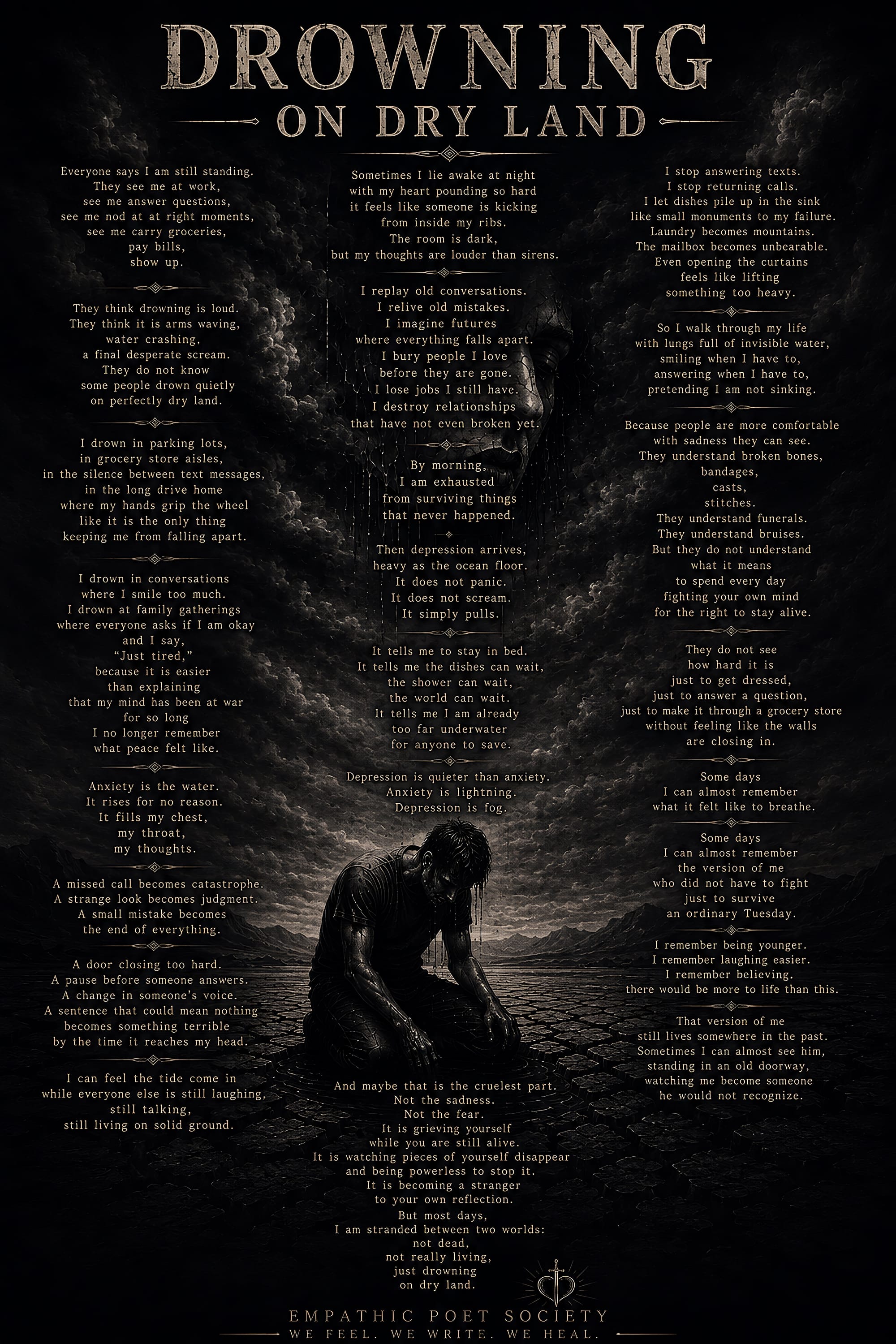
Everyone says I am still standing. They see me at work, see me answer questions, see me nod at the right moments, see me carry groceries, pay bills, show up.
They think drowning is loud. They think it is arms waving, water crashing, a final desperate scream.
They do not know some people drown quietly on perfectly dry land.
I drown in parking lots, in grocery store aisles, in the silence between text messages, in the long drive home where my hands grip the wheel like it is the only thing keeping me from falling apart.
I drown in conversations where I smile too much. I drown at family gatherings where everyone asks if I am okay and I say, “Just tired,” because it is easier than explaining that my mind has been at war for so long I no longer remember what peace felt like.
Anxiety is the water. It rises for no reason. It fills my chest, my throat, my thoughts.
A missed call becomes catastrophe. A strange look becomes judgment. A small mistake becomes the end of everything.
A door closing too hard. A pause before someone answers. A change in someone’s voice. A sentence that could mean nothing becomes something terrible by the time it reaches my head.
I can feel the tide come in while everyone else is still laughing, still talking, still living on solid ground.
Sometimes I lie awake at night with my heart pounding so hard it feels like someone is kicking from inside my ribs.
The room is dark, but my thoughts are louder than sirens.
I replay old conversations. I relive old mistakes. I imagine futures where everything falls apart.
I bury people I love before they are gone. I lose jobs I still have. I destroy relationships that have not even broken yet.
By morning, I am exhausted from surviving things that never happened.
Then depression arrives, heavy as the ocean floor. It does not panic. It does not scream. It simply pulls.
It tells me to stay in bed. It tells me the dishes can wait, the shower can wait, the world can wait. It tells me I am already too far underwater for anyone to save.
Depression is quieter than anxiety. Anxiety is lightning. Depression is fog.
It rolls in slowly, soft enough that I do not notice it at first. Then one day, I look around and realize I cannot see anything anymore.
The things I used to love begin to feel far away. Music becomes noise. Food becomes obligation. Sleep becomes escape. The people I care about begin to sound distant, like voices coming through water.
I stop answering texts. I stop returning calls. I let dishes pile up in the sink like small monuments to my failure.
Laundry becomes mountains. The mailbox becomes unbearable. Even opening the curtains feels like lifting something too heavy.
So I walk through my life with lungs full of invisible water, smiling when I have to, answering when I have to, pretending I am not sinking.
Because people are more comfortable with sadness they can see.
They understand broken bones, bandages, casts, stitches.
They understand funerals. They understand bruises.
But they do not understand what it means to spend every day fighting your own mind for the right to stay alive.
They do not see how hard it is just to get dressed, just to answer a question, just to make it through a grocery store without feeling like the walls are closing in.
Some days I can almost remember what it felt like to breathe.
Some days I can almost remember the version of me who did not have to fight just to survive an ordinary Tuesday.
I remember being younger. I remember laughing easier. I remember believing there would be more to life than this.
That version of me still lives somewhere in the past. Sometimes I can almost see him, standing in an old doorway, watching me become someone he would not recognize.
And maybe that is the cruelest part. Not the sadness. Not the fear.
It is grieving yourself while you are still alive.
It is watching pieces of yourself disappear and being powerless to stop it.
It is becoming a stranger to your own reflection.
But most days, I am stranded between two worlds: not dead, not really living, just drowning on dry land.